Bioactive vs. Rack Systems for Ball Python Breeding Females
By HatchLedger Editorial Team · Published 2025-06-14 · Updated Mar 13, 2026
The question of whether to house breeding females in bioactive naturalistic setups or in production-oriented rack systems is one the ball python community debates regularly. Both approaches work. They have different strengths, different maintenance requirements, and different implications for breeding performance. Breeders using integrated software report 30% less time on administrative tasks, which helps regardless of which housing approach you choose.
TL;DR
- Ball python breeding operations require systematic record-keeping from pre-season preparation through end-of-season sales.
- Females at 1,200-1,500g or more are the target weight before introducing them to a breeding male.
- Ovulation detection is the key event that anchors pre-lay shed and lay date calculations.
- Clutch profitability guide depends on understanding actual cost basis per animal, not just gross sale revenue.
- Well-documented animals with complete feeding histories and clear genetic records consistently sell faster and at higher prices.
What Is a Bioactive Enclosure?
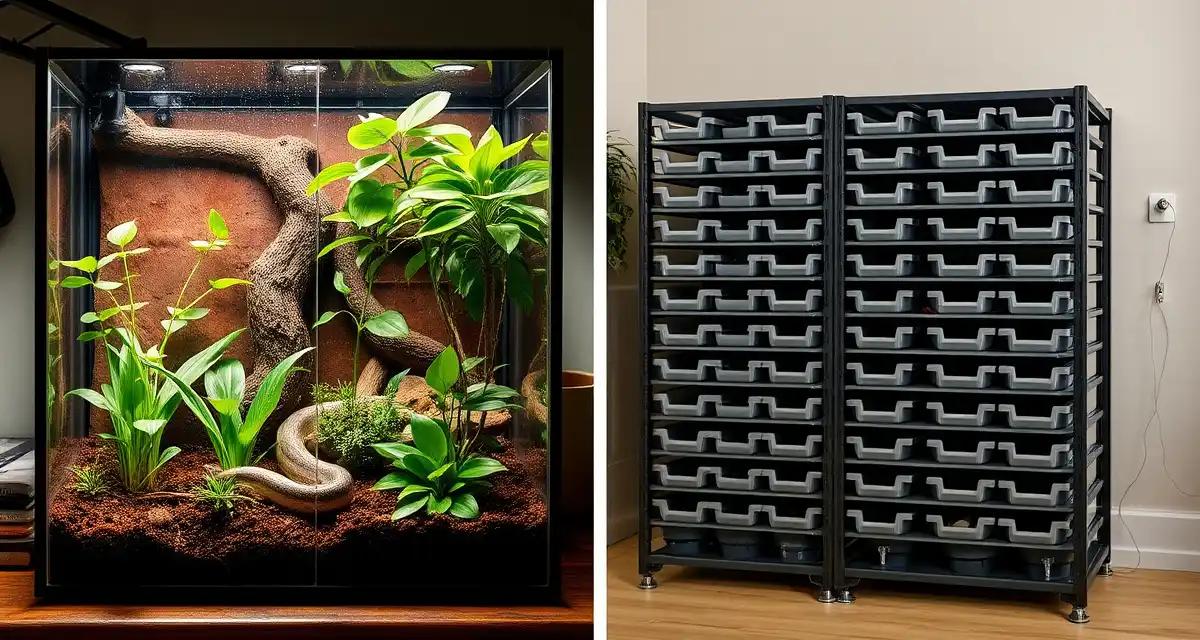
A bioactive enclosure is a living ecosystem within the enclosure. It includes:
- A naturalistic substrate mix that supports microfauna (springtails and isopods)
- Live plants (or high-quality artificial plants)
- Multiple hides and environmental enrichment
- The microfauna that process waste, reducing the keeper's cleaning workload
Bioactive setups are designed to mimic the animal's natural environment more closely than a bare rack tub. The micro-cleanup crew handles much of the fecal decomposition, and plants maintain humidity and provide environmental complexity.
What Is a Rack System?
A rack system houses animals in plastic tubs (typically solid-colored tubs with ventilation holes) stacked in a rack frame. Heat tape runs along tub positions for belly heat. Substrate is typically paper towels for easy cleaning.
Racks are designed for efficiency: many animals managed in minimal space with quick access, easy cleaning, and consistent environmental control.
Breeding Performance Comparison
Rack systems: Decades of evidence that ball pythons breed successfully and reliably in rack housing. Commercial-scale operations producing hundreds of clutches per year use rack systems almost exclusively. The environmental conditions (temperature gradient, humidity, security) can be maintained consistently. Animals in racks with appropriate hides and temperatures are not obviously stressed compared to naturalistic setups.
Bioactive setups: Some breeders report that breeding females in larger, naturalistic setups with more environmental complexity show stronger follicular development and more consistent breeding behavior. This is anecdotal rather than controlled data, but the reasoning is plausible - environmental enrichment may reduce chronic stress, which benefits reproductive performance.
The honest assessment: A well-managed rack with appropriate temperatures, proper hides, and consistent husbandry will produce clutches. A poorly set up bioactive enclosure that doesn't maintain proper temperatures or provides inadequate security won't outperform a good rack. The husbandry execution matters more than the housing philosophy.
Practical Tradeoffs
Cost: A high-quality bioactive setup for a 3,500-gram adult female costs substantially more than a rack tub. If you're housing 20 breeding females, this difference becomes significant.
Space: Appropriately sized bioactive enclosures for adult ball pythons are large (minimum 4x2x2 feet for a big female). Racks house the same number of animals in a fraction of the floor space.
Maintenance: Bioactive setups, when functioning well, require less active cleaning but more initial setup and monitoring to maintain the living system. Rack tubs require consistent cleaning but are predictable in their maintenance needs.
Temperature control: Maintaining precise temperature gradients in large enclosures requires good equipment and monitoring. Rack systems with proportional thermostats maintain very consistent belly heat across many animals simultaneously.
Observation: Naturalistic setups with plants and deep substrate can make it harder to observe animals. In a rack tub, you see the animal immediately when you open the tub.
Hybrid Approaches
Many breeders with breeding females use rack housing for most of the year and move females to larger, well-equipped enclosures for the pre-lay period specifically. This gives the female appropriate space and humidity for the lay box while maintaining the efficiency of rack housing for the rest of the year.
Track housing changes for each animal in HatchLedger's animal records so you know where each female is at any given point in the season. For tools that support this kind of housing note documentation, see the reptile breeder software comparison.
Frequently Asked Questions
What is the best approach to choosing between bioactive and rack housing for ball python breeding females?
Evaluate your priorities: if efficiency at scale is paramount, racks are the proven approach. If you have fewer females and can invest in quality naturalistic setups, bioactive can work well and may benefit the animals' quality of life. In either case, the specific husbandry (correct temperatures, proper hides, clean water, appropriate humidity) determines breeding performance more than the housing philosophy.
How do professional breeders handle housing decisions for breeding female ball pythons?
Most large-scale professional breeders use rack systems for the efficiency they provide at scale. Some breeders who focus on quality over volume invest in larger, more enriched setups for their breeding females. The most common approach in medium-scale programs is racks for most animals with a few larger enclosures for the most valuable females or for females in the pre-lay period. There's no single "right" answer that applies across all programs.
What software helps manage ball python housing records across rack and naturalistic setups?
HatchLedger is purpose-built for reptile breeders, connecting animal records, breeding history, clutch outcomes, and financial tracking in one system. Unlike generic spreadsheets, it's designed around the specific workflow of an active breeding season. Free for up to 20 animals.
What records should every reptile breeder maintain per animal?
At minimum: acquisition date and source, morph and genetic documentation, feeding log, weight history, any veterinary treatments, and breeding history including pairing dates, clutch of origin for captive-bred animals, and offspring records. These records serve your own management, buyer documentation, regulatory compliance, and long-term genetic tracking.
How should reptile breeders document genetics for buyers?
A complete genetic record for sale includes the animal's visual morph name, confirmed het genes and their basis (parentage documentation or proven-out production), possible het genes with probability percentages, hatch date, and parent morph information. Including clutch-of-origin records lets buyers independently verify the claims.
What is Bioactive vs. Rack Systems for Ball Python Breeding Females?
Bioactive and rack systems are two distinct housing approaches for ball python breeding females. Bioactive enclosures mimic natural habitats using live substrate, microfauna like springtails and isopods, and enrichment elements. Rack systems use plastic tubs in stacked racks, prioritizing space efficiency and environmental control. Both successfully support breeding, but they differ significantly in cost, maintenance, monitoring ease, and scalability. The right choice depends on your operation size, budget, and husbandry philosophy.
How much does Bioactive vs. Rack Systems for Ball Python Breeding Females cost?
Rack systems are the lower-cost option upfront — a basic tub setup can cost $20–$60 per female. Bioactive enclosures range from $150–$400+ per animal depending on enclosure size, substrate mix, plants, and microfauna colonies. Ongoing costs also differ: bioactive setups require occasional plant replacement and substrate top-offs, while racks involve more frequent substrate changes. Large-scale breeders often favor racks for cost efficiency; hobbyist breeders may find bioactive setups worthwhile for enrichment and aesthetics.
How does Bioactive vs. Rack Systems for Ball Python Breeding Females work?
Rack systems work by housing females in individual plastic tubs with controlled heat tape underneath, maintaining stable belly heat of 88–92°F. Monitoring feeding, shed cycles, and ovulation is straightforward. Bioactive setups work by creating a self-sustaining micro-ecosystem where microfauna break down waste, reducing cleaning frequency. Both methods require tracking weight, feeding response, and reproductive events. Breeders using record-keeping software can monitor key milestones like ovulation and pre-lay shed timing regardless of which housing system they use.
What are the benefits of Bioactive vs. Rack Systems for Ball Python Breeding Females?
Rack systems offer easy visual checks, consistent thermal gradients, space efficiency, and simplified record-keeping — ideal for tracking feeding and reproductive cycles across many females. Bioactive enclosures provide psychological enrichment, reduced waste odor, lower cleaning frequency once established, and more naturalistic conditions that may reduce stress. Stress reduction can positively impact feeding consistency and reproductive performance. Both systems support successful breeding when properly maintained, and neither offers a universal advantage over the other for all breeders.
Who needs Bioactive vs. Rack Systems for Ball Python Breeding Females?
Rack systems suit commercial and production-scale breeders managing large female collections where efficiency, consistency, and cost control are priorities. Bioactive setups appeal to hobbyist breeders, small-scale operations, or those focused on animal welfare and enrichment. Breeders with females prone to feeding refusals or stress-related issues sometimes find bioactive environments helpful. Any breeder tracking ovulation, clutch data, and genetics benefits from systematic record-keeping regardless of housing choice, since documentation quality affects both breeding outcomes and resale value.
How long does Bioactive vs. Rack Systems for Ball Python Breeding Females take?
Rack systems can be set up in hours and become functional immediately. Bioactive enclosures take longer — substrate must be layered correctly, microfauna colonies need 4–8 weeks to establish before introducing the animal. Once established, bioactive setups require less hands-on maintenance than racks. Breeding season preparation timelines are the same either way: females should reach target weight of 1,200–1,500g before breeding introductions, and ovulation detection anchors all downstream timing for pre-lay shed and expected lay dates.
Related Articles
- Ball Python Breeding Season Review: How to Analyze Your Season and Plan the Next One
- Ball Python Cinnamon Morph Breeding Guide: Genetics, Combos, and What to Expect
Sources
- USARK (United States Association of Reptile Keepers)
- Association of Reptilian and Amphibian Veterinarians (ARAV)
- World of Ball Pythons (WoBP genetics reference database)
- MorphMarket (reptile industry marketplace)
- Reptiles Magazine (Bowtie Inc.)
Get Started with HatchLedger
Every part of a ball python breeding operation -- from pairing records to clutch documentation to financial tracking -- works better when the data is connected rather than scattered across notebooks and spreadsheets. HatchLedger is built for exactly that. Try it free with up to 20 animals.