Scaling a Ball Python Breeding Program from Hobbyist to Professional
By HatchLedger Editorial Team · Published 2025-06-07 · Updated Mar 13, 2026
Moving from a small hobby breeding program to something that resembles a real business is a significant operational shift. The animals and the genetics guide are what most breeders focus on, but the challenges of scaling are mostly operational and financial - record-keeping demands multiply, cash flow becomes a real constraint, space and equipment costs escalate, and the time investment crosses a threshold where it affects other parts of your life. Breeders using integrated software report 30% less time on administrative tasks, and at scale, that efficiency difference is the gap between a program you can manage and one that manages you.
TL;DR
- Ball python breeding operations require systematic record-keeping from pre-season preparation through end-of-season sales.
- Females at 1,200-1,500g or more are the target weight before introducing them to a breeding male.
- Ovulation detection is the key event that anchors pre-lay shed and lay date calculations.
- Clutch profitability guide depends on understanding actual cost basis per animal, not just gross sale revenue.
- Well-documented animals with complete feeding histories and clear genetic records consistently sell faster and at higher prices.
This isn't a discouraging picture. Many people have built genuinely successful professional ball python programs. But understanding what the transition actually requires - beyond just having more animals - is what separates programs that scale successfully from ones that grow quickly and then burn out.
What Changes When You Scale
A small hobby program with 5-10 breeding females operates very differently from a mid-scale operation with 30-50 breeding females. The differences aren't just quantitative.
Record-keeping complexity: At small scale, you can hold a lot of information in your head and supplement with basic notes. At scale, memory and informal notes fail. You need systems - not because you're less capable, but because the volume of information exceeds what any individual can manage reliably. A 40-female program produces dozens of clutches per season, each with multiple animals to track through incubation, hatching, feeding establishment, sexing, morph documentation, and sale. Without organized records, things fall through the cracks daily.
Financial management: At hobby scale, profit and loss is loose and informal. When breeding is a business, you need to know your actual cost per hatchling, your margin per combination, your seasonal P&L, and your cash flow position. Equipment costs, animal acquisition, and operating expenses front-load the cash requirement. Revenue comes later, when animals sell. This mismatch requires planning and usually some working capital.
Time commitment: A hobby program fits around your life. A professional program demands time that competes with everything else - employment, family, other obligations. Before scaling, honestly assess what time you actually have available and whether the program you're planning fits within it without creating a situation you can't sustain.
Legal and regulatory requirements: At some revenue threshold, your breeding program is a business for tax purposes whether you've formalized it or not. Understanding your obligations - income reporting, potential sales tax depending on jurisdiction, any applicable state or local permits for a commercial breeding operation - is not optional at scale.
The Records Foundation for Professional Programs
The single most important operational change in moving to professional scale is building a records infrastructure that works at volume before you need it.
Animal-centric records: Every animal in your program needs a unique identifier, and all records (feeding, health events, weights, genetic assignments, pairing history) need to link to that identifier. At scale, an animal without a clear identifier and complete record is a liability - you can't sell it confidently, you can't document its genetics reliably, and you can't make data-driven decisions about its management.
Clutch records linked to pairings: Each clutch record should connect to the specific pairing that produced it, with all outcome data (fertile eggs, hatch rate, slug rate, morph outcomes) recorded consistently. At scale, this is where your product is manufactured. Incomplete clutch records are incomplete production records for a manufacturing operation.
Financial records separate from banking: Running your breeding program's income and expenses through a dedicated account, not your personal account, is both practically useful and important for any tax documentation. It makes your year-end financial review much simpler and creates a clear picture of the business's performance.
Sales records: A complete log of every animal sold, with buyer information, sale price, date, and morph/genetics documentation. This matters for tax purposes and for dispute resolution if a buyer later claims a genetic discrepancy.
Scaling the Physical Infrastructure
More animals require more space, more equipment, and more utility costs. Plan physical expansion deliberately rather than reactively.
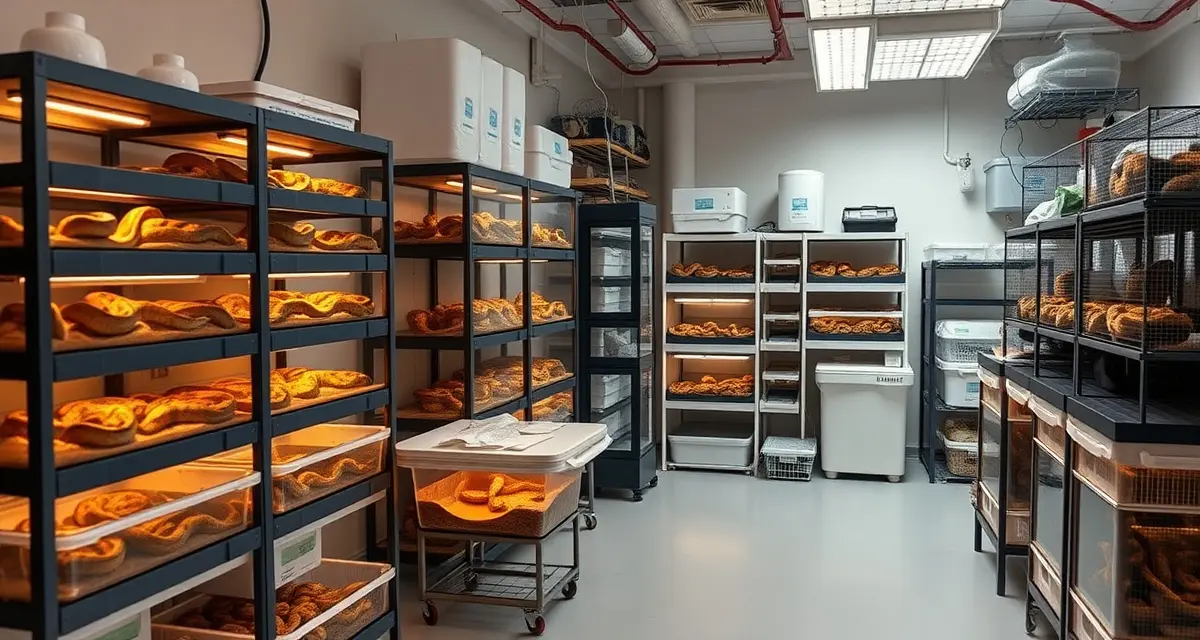
Rack systems for scalable housing: Purpose-built rack systems from established manufacturers (Animal Plastics, Vision Racks, and others) are the standard for professional-scale operations. They maximize space efficiency, simplify maintenance routines, and are designed for the specific thermal needs of ball pythons. Improvised housing that works at small scale becomes a management and efficiency problem at large scale.
Dedicated incubation space: At scale, you're running multiple incubators simultaneously with multiple clutches at different stages. Your incubation area needs to maintain stable temperature and humidity independent of the ambient conditions in your breeding room, and it needs enough capacity that a busy production season doesn't require incubation improvisation.
Climate control for the breeding room: Heating and cooling the breeding room efficiently is a significant operating cost. Good insulation, efficient heating equipment, and appropriate room design reduce ongoing utility costs materially.
Building a Sustainable Animal Inventory
One of the most common mistakes in scaling is acquiring animals faster than the program can absorb and manage them well. More animals with mediocre management produces worse outcomes and more stress than a carefully managed smaller collection.
Scale animal inventory in proportion to your operational capacity. If your records system, your time, your space, and your financial resources can support 25 breeding females this season, adding 30 more females because you found good deals is a recipe for operational collapse.
The best scaling plans are deliberate: define the program size you're aiming for, identify what operational improvements are needed at each growth stage, and grow into each stage before taking the next step.
Marketing and Sales at Scale
A professional program's output needs a professional sales approach. This means consistent MorphMarket presence, organized listing practices, responsive buyer communication, professional hatch photos, and clear policies for deposits, shipping, and disputes.
At scale, buyer reputation is a significant asset. A reputation for accurate genetics documentation, good communication, and quality animals builds a customer base that returns each season. A reputation for disorganization or inaccurate morph identification is very hard to recover from in a community where information moves quickly.
Build your record-keeping and operational systems with professional-scale growth in mind from the beginning in HatchLedger's breeding management system. For how different tools support operations at different scales, see the reptile breeder software comparison.
Frequently Asked Questions
What is the best approach to scaling a ball python breeding program from hobbyist to professional?
Build the operational infrastructure before you need it, not after you outgrow your current system. This means proper record-keeping for every animal, structured financial tracking with a dedicated breeding account, physical infrastructure designed for efficiency at target scale, and marketing practices that build a professional reputation. Scale animal inventory in proportion to your management capacity rather than as fast as acquisition opportunities allow. The programs that scale successfully grow their operations and their infrastructure together rather than letting the collection outpace the systems managing it.
How do professional ball python breeders manage the transition to running a real business?
Experienced breeders who've made this transition consistently identify record-keeping and time management as the biggest operational challenges - not the animals themselves. They formalize their finances early (dedicated account, expense tracking, income reporting), invest in purpose-built housing before improvised solutions become a problem, and build consistent routines that make management of a large collection predictable rather than chaotic. Many also identify a specific scale they're targeting and plan deliberately toward it rather than growing reactively.
What software helps manage a scaling ball python breeding program?
HatchLedger is purpose-built for reptile breeders, connecting animal records, breeding history, clutch outcomes, and financial tracking in one system. Unlike generic spreadsheets, it's designed around the specific workflow of an active breeding season. Free for up to 20 animals.
What records should every reptile breeder maintain per animal?
At minimum: acquisition date and source, morph and genetic documentation, feeding log, weight history, any veterinary treatments, and breeding history including pairing dates, clutch of origin for captive-bred animals, and offspring records. These records serve your own management, buyer documentation, regulatory compliance, and long-term genetic tracking.
How should reptile breeders document genetics for buyers?
A complete genetic record for sale includes the animal's visual morph name, confirmed het genes and their basis (parentage documentation or proven-out production), possible het genes with probability percentages, hatch date, and parent morph information. Including clutch-of-origin records lets buyers independently verify the claims.
What is Scaling a Ball Python Breeding Program from Hobbyist to Professional?
Scaling a ball python breeding program from hobbyist to professional means transitioning from a small personal collection into a structured operation with consistent revenue, systematic record-keeping, and deliberate genetic planning. It involves treating your collection as a business — managing cash flow, tracking cost basis per animal, optimizing hatch rates, and building a reputation for well-documented, quality animals. The shift is less about acquiring more snakes and more about building the operational infrastructure that makes a larger program sustainable and manageable long-term.
How much does Scaling a Ball Python Breeding Program from Hobbyist to Professional cost?
There is no single fixed cost — scaling expenses depend on your starting point and target scale. Key cost drivers include additional enclosures and rack systems, climate control equipment, feeder supply infrastructure, and software or record-keeping tools. A realistic mid-scale operation might require $5,000–$20,000 in infrastructure investment. The more important financial discipline is understanding your cost basis per animal produced, since profitability depends on knowing actual expenses against sale revenue, not just gross income from clutch sales.
How does Scaling a Ball Python Breeding Program from Hobbyist to Professional work?
Scaling works by systematically expanding each phase of your breeding season: pairing females at target weight (1,200–1,500g+), detecting ovulation to anchor pre-lay shed and lay date timelines, incubating clutches consistently, and selling well-documented hatchlings. As volume increases, manual tracking breaks down — successful scaling requires integrated record-keeping that connects genetic pairings, feeding histories, incubation logs, and sales data. Breeders using dedicated software report roughly 30% less time on administrative tasks, which compounds significantly at higher animal counts.
What are the benefits of Scaling a Ball Python Breeding Program from Hobbyist to Professional?
The core benefits include turning a time-intensive hobby into a sustainable income stream, building a marketable reputation for quality genetics and documentation, and gaining the operational clarity to make smart pairing decisions year over year. Well-documented animals with complete feeding and genetic records sell faster and at higher prices. Beyond revenue, a professionally run program is simply less stressful — systematic processes replace reactive firefighting, and you spend more time on the animals and genetics you actually enjoy.
Who needs Scaling a Ball Python Breeding Program from Hobbyist to Professional?
Anyone who finds their hobby program growing beyond what informal notes and memory can reliably track is a candidate for this transition. Practically, this means breeders producing multiple clutches per season, working with valuable or complex morphs where genetic accuracy matters, or anyone whose breeding income is becoming a meaningful part of their household finances. If the administrative side of your program is consuming evenings and weekends, or if you have lost track of pairing records or feeding histories, scaling your systems — not just your animal count — is the next step.
How long does Scaling a Ball Python Breeding Program from Hobbyist to Professional take?
The timeline from hobbyist to professional is typically two to four breeding seasons. The first season you implement structured systems — record-keeping, cost tracking, formal genetic planning. The second season you refine based on what broke down. By the third or fourth season, operational patterns are stable enough to focus on growth rather than fixing process gaps. Biological timelines are fixed: females breed seasonally, clutches incubate roughly 55–60 days, and hatchlings need time before sale. The business infrastructure, however, can be built in parallel year-round.
Related Articles
Sources
- USARK (United States Association of Reptile Keepers)
- Association of Reptilian and Amphibian Veterinarians (ARAV)
- World of Ball Pythons (WoBP genetics reference database)
- MorphMarket (reptile industry marketplace)
- Reptiles Magazine (Bowtie Inc.)
Get Started with HatchLedger
Every part of a ball python breeding operation -- from pairing records to clutch documentation to financial tracking -- works better when the data is connected rather than scattered across notebooks and spreadsheets. HatchLedger is built for exactly that. Try it free with up to 20 animals.