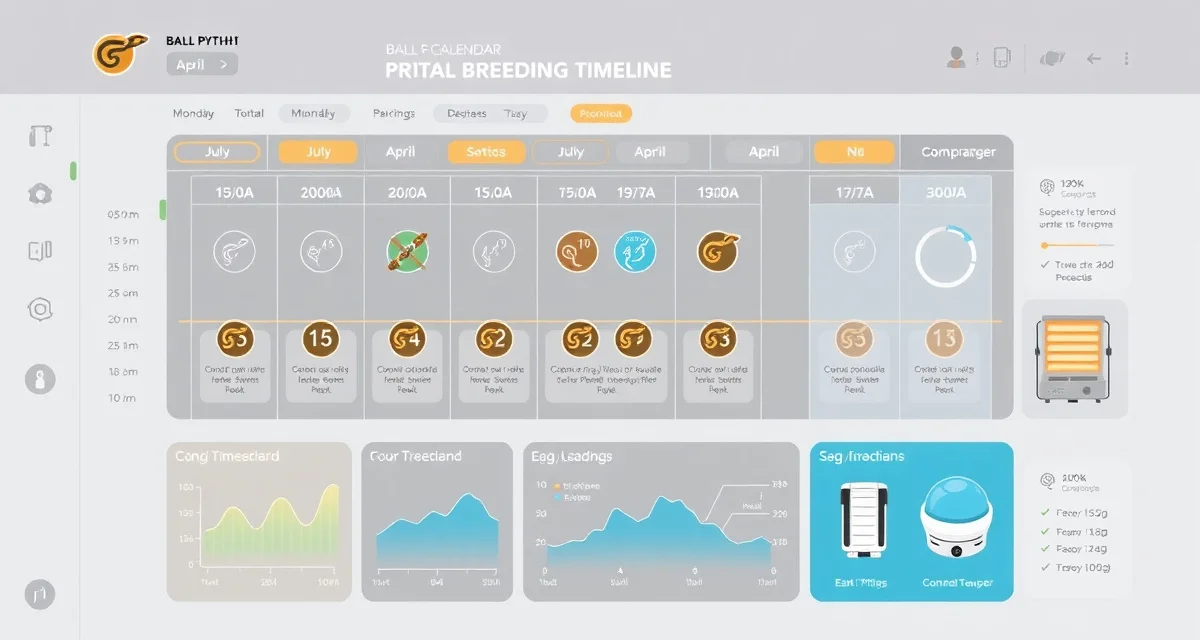
Ball Python Breeding Season Calendar: Monthly Management Guide
By HatchLedger Editorial Team · Published 2025-04-26 · Updated Mar 13, 2026
Breeders using integrated software report 30% less time on administrative tasks, and calendar-based management is a key reason why. When you know what you should be doing every month of the year, you stop reacting to events and start anticipating them. Your incubator is ready before eggs need to go in. Your nest boxes are set up before the pre-lay shed. Your females are conditioned before cycling begins.
TL;DR
- Ball python breeding operations require systematic record-keeping from pre-season preparation through end-of-season sales.
- Females at 1,200-1,500g or more are the target weight before introducing them to a breeding male.
- Ovulation detection is the key event that anchors pre-lay shed and lay date calculations.
- Clutch profitability guide depends on understanding actual cost basis per animal, not just gross sale revenue.
- Well-documented animals with complete feeding histories and clear genetic records consistently sell faster and at higher prices.
This monthly guide covers a typical breeding season cycle for ball python breeders in North America. Adjust for your specific climate and the particular animals you're working with, but the general framework holds across most production operations.
July-August: Pre-Season Conditioning
Your breeding season starts months before you introduce your first pair. Females need to be at appropriate weight and body condition before you start cooling. Use these months to:
Feed aggressively. If your females are below your target breeding weight (typically 1,500g+ for most adults), push feeding frequency. Move from every 10-14 days to every 7-10 days with appropriately sized prey. A female coming out of breeding season at 1,400g needs to gain 200-400g before next season.
Assess body condition. Score every female on the 1-5 BCS scale. Animals at BCS 2 need priority feeding. Animals already at BCS 3.5 can maintain their current schedule.
Address any health issues. Don't start a breeding female into the cooling cycle if she has an active health problem. Stomatitis, respiratory symptoms, retained sheds, and parasites should all be addressed and resolved before cycling.
Assess your collection. Which pairings are you running this season? Which animals are reaching breeding size for the first time? Which morphs do you need to add for project development? Make your plan now.
September-October: Cooling Initiation
Begin your cooling protocol. Gradual temperature reduction over 3-4 weeks is better than an abrupt drop.
Weeks 1-2 of September: Begin reducing temperatures. Drop the hot spot from 90F to 84-86F. Reduce feeding frequency slightly.
Weeks 3-4 of September: Continue the gradient reduction. Hot spot to 80-82F. Night temps dropping to 72-74F.
October: Establish your full cool-period parameters. Many breeders target 76-78F ambient with night drops to 70-72F. Some breeders drop even further, to 68-70F nights, particularly for stubborn females. Adjust photoperiod to 8-10 hours of light.
Weigh all breeding animals at the start of cooling to establish a baseline.
Males: Watch for the behavioral changes that indicate sexual readiness: restlessness, increased activity, constant tongue-flicking. Males often come into breeding condition within 3-4 weeks of cooling.
November-December: Active Breeding Season
This is when you start introducing pairs. Males that are clearly ready can begin introductions to females who are showing early signs of cycling receptivity.
Introduction schedule: Run 8-12 hour overnight introductions every 3-7 days per pair. Observe the first 15-30 minutes of each introduction for activity level.
Record every introduction. Date, which male, which female, duration, observations. This becomes the pairing history that either explains or raises questions about your clutch outcomes months later.
Continue monitoring female weight. Weigh breeding females monthly throughout the season. Males also need weight monitoring if being used actively across multiple females.
Feeding: Many females slow down or stop eating during breeding season. Don't stress them with repeated uneaten offerings. Offer every 2-3 weeks; accept refusals without concern unless weight loss becomes notable.
January-February: Peak Pairing Season
Most ball python ovulations in captive collections occur in January, February, and March. Continue active pairings, watching closely for ovulation events.
Check females daily for the characteristic mid-body swelling that indicates ovulation. Once you see it, log the date immediately.
Post-ovulation: Continue pairings for 7-14 days post-ovulation, then stop. Watch for the pre-lay shed, which typically follows 18-28 days after ovulation.
Set up nest boxes in female enclosures around days 15-16 post-ovulation, before the expected pre-lay shed window.
Prepare your incubator. If you haven't already tested your incubator this season, do it now. You don't want to discover a thermostat problem the night before eggs need to go in.
March-April: Laying Season and Incubation
First clutches of the season are going in the incubator. New clutches will continue arriving as later-ovulating females go through their cycles.
Check nest boxes daily once pre-lay sheds are observed. Most females lay within 10 days of completing the pre-lay shed.
Transfer eggs promptly. Mark tops before moving, don't rotate, get into the incubator quickly.
Continue pairings for females that haven't yet ovulated. Your breeding season isn't over just because some females have laid.
Feed post-lay females within 48-72 hours of laying. Aggressive refeeding starts here.
May-June: Incubation and First Hatches
Clutches from January-February ovulations are hatching. Continue managing later incubating clutches.
Check incubation containers every 7-10 days for humidity and every day as eggs approach the expected hatch date.
First hatches: Set up hatchling housing before the first pip appears. Have feeders on hand for first feeding attempts after first shed.
Track every hatchling: ID, morph, sex (or confirm sex after first shed), hatch date, birth weight.
Begin refeeding program for all post-lay females. These animals have been through a notable metabolic demand cycle.
June-July: Hatchling Management and Late Clutches
Most breeding operations have their main hatch cohort out by June-July. Some late-season pairings may still be incubating.
Establish feeding for all hatchlings. Priority focus is getting every hatchling eating reliably on frozen/thawed before sales season hits.
Weigh all adults. How did your breeding females come through the season? Which ones need extra conditioning before the next season begins?
Inventory your collection. What's selling? What's sitting? Adjust pricing and listing strategy.
Financial review. Calculate actual P&L for each clutch produced. How did this season's results compare to projections? What would you do differently?
This entire calendar is trackable in HatchLedger's breeding project and clutch management tools. Logging milestone dates against their expected windows tells you at a glance whether your season is running on schedule and where you might be behind.
The HatchLedger reptile breeder software keeps your year-round operational picture in one place, connecting the breeding season calendar to individual animal records, health logs, and financial data.
Frequently Asked Questions
What is the best approach to ball python breeding season calendar management?
Start conditioning females in July-August (2-3 months before cooling), begin cooling protocols in September-October, run active pairings November through March, and manage incubation and hatching from April through June. Mark ovulation dates immediately; your entire post-breeding timeline depends on that date.
How do professional breeders handle annual breeding season calendar management?
Experienced breeders use a detailed calendar to anticipate milestones rather than react to them. They have incubation equipment verified before it's needed, hatchling housing ready before the first pip, and conditioning programs for females starting months before cooling.
What records should every reptile breeder maintain per animal?
At minimum: acquisition date and source, morph and genetic documentation, feeding log, weight history, any veterinary treatments, and breeding history including pairing dates, clutch of origin for captive-bred animals, and offspring records. These records serve your own management, buyer documentation, regulatory compliance, and long-term genetic tracking.
How should reptile breeders document genetics for buyers?
A complete genetic record for sale includes the animal's visual morph name, confirmed het genes and their basis (parentage documentation or proven-out production), possible het genes with probability percentages, hatch date, and parent morph information. Including clutch-of-origin records lets buyers independently verify the claims.
What is Ball Python Breeding Season Calendar: Monthly Management Guide?
A Ball Python Breeding Season Calendar is a month-by-month management framework that guides breeders through every phase of the breeding cycle — from pre-season conditioning in July through end-of-season sales. It covers female weight targets, cycling protocols, ovulation detection, incubation management, and hatchling care. Rather than reacting to events as they happen, the calendar approach lets breeders anticipate each stage, prepare equipment in advance, and maintain consistent records throughout the entire production year.
How much does Ball Python Breeding Season Calendar: Monthly Management Guide cost?
The Ball Python Breeding Season Calendar is a free educational guide published on HatchLedger. There is no purchase required to access the monthly management framework. HatchLedger does offer breeding management software that complements the calendar approach, helping breeders automate record-keeping and track clutch profitability. Breeders using integrated software tools report spending roughly 30% less time on administrative tasks compared to manual tracking methods.
How does Ball Python Breeding Season Calendar: Monthly Management Guide work?
The calendar works by dividing the breeding year into monthly phases, each with specific tasks and milestones. Starting in July with female conditioning, breeders follow a structured sequence: cycling animals into breeding season, introducing pairs, monitoring for ovulation, preparing nest boxes before pre-lay shed, managing incubation, and tracking hatchling development through sales. Ovulation detection anchors the timeline, allowing breeders to calculate expected lay dates and incubation completion windows with reasonable accuracy.
What are the benefits of Ball Python Breeding Season Calendar: Monthly Management Guide?
A structured breeding calendar reduces guesswork, prevents missed milestones, and improves clutch outcomes. Females conditioned to target weight before cycling produce healthier clutches. Equipment is ready before it is needed. Detailed records of feeding history and genetics make animals easier to sell at higher prices. Breeders who document consistently report faster sales and stronger buyer confidence. The calendar also supports cost-basis tracking, so profitability per clutch reflects real expenses rather than just gross revenue.
Who needs Ball Python Breeding Season Calendar: Monthly Management Guide?
Any ball python breeder managing multiple females or planning to scale their operation benefits from a structured breeding calendar. Hobbyists transitioning to production-level breeding especially benefit, as the monthly framework replaces informal habits with repeatable processes. Breeders working with high-value morphs, where documentation directly affects resale price, gain the most from consistent record-keeping. The guide is relevant across North American climates, with the flexibility to adjust timing based on specific animals and local conditions.
How long does Ball Python Breeding Season Calendar: Monthly Management Guide take?
A full ball python breeding season spans roughly 10 to 12 months from initial conditioning through final hatchling sales. Pre-season conditioning begins in July or August. Breeding introductions typically run through fall and winter. Females lay eggs in late winter to spring, with incubation lasting approximately 55 to 60 days. Hatchlings make their first feeds by summer, and sales activity peaks in late summer and fall — completing the annual cycle before the next conditioning phase begins.
Related Articles
- Ball Python Clown Morph Breeding Guide: Recessive Genetics and Top Combos
- Ball Python Enchi Morph: Breeding Guide, Top Combos, and Genetic Ratios
Sources
- USARK (United States Association of Reptile Keepers)
- Association of Reptilian and Amphibian Veterinarians (ARAV)
- World of Ball Pythons (WoBP genetics reference database)
- MorphMarket (reptile industry marketplace)
- Reptiles Magazine (Bowtie Inc.)
Get Started with HatchLedger
Every part of a ball python breeding operation -- from pairing records to clutch documentation to financial tracking -- works better when the data is connected rather than scattered across notebooks and spreadsheets. HatchLedger is built for exactly that. Try it free with up to 20 animals.