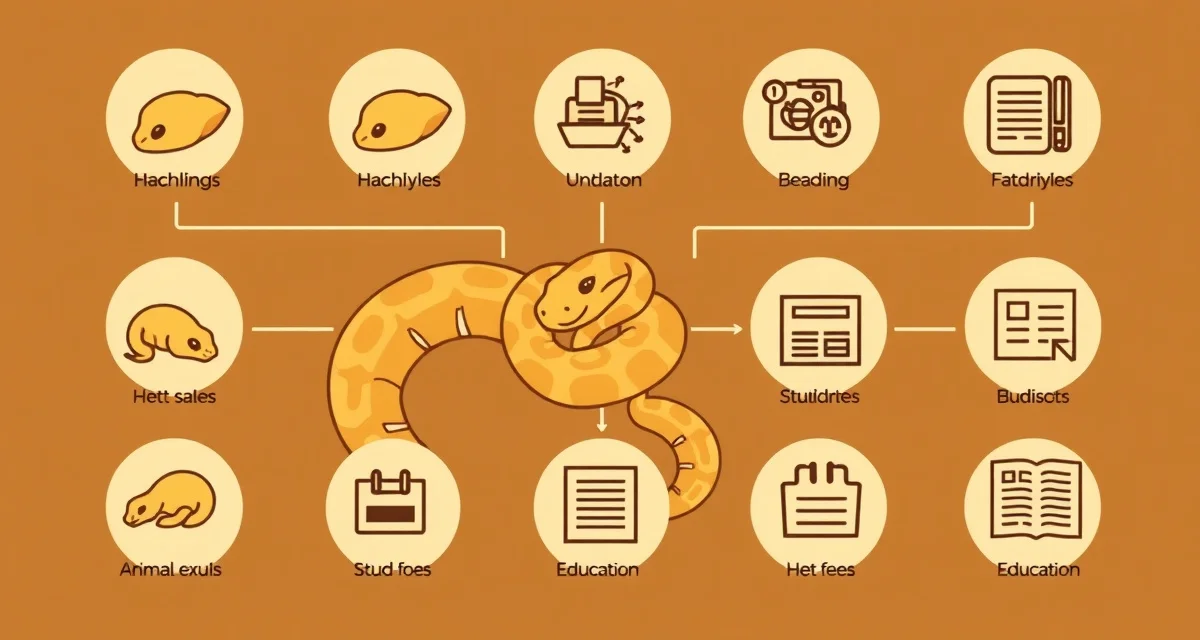
8 Revenue Streams for Ball Python Breeding Businesses
By HatchLedger Editorial Team · Published 2025-02-13 · Updated Mar 13, 2026
Most beginning breeders think their only revenue is hatchlings sold on MorphMarket. That's a revenue stream, but it's not the only one. Experienced breeders diversify their income in ways that make operations more stable and more profitable overall.
TL;DR
- Ball python breeding operations require systematic record-keeping from pre-season preparation through end-of-season sales.
- Females at 1,200-1,500g or more are the target weight before introducing them to a breeding male.
- Ovulation detection is the key event that anchors pre-lay shed and lay date calculations.
- Clutch profitability guide depends on understanding actual cost basis per animal, not just gross sale revenue.
- Well-documented animals with complete feeding histories and clear genetic records consistently sell faster and at higher prices.
1. Hatchling Sales (MorphMarket and Direct)
This is the obvious one. You breed animals, you hatch eggs, you sell hatchlings. MorphMarket is the primary platform. Reptile expos are a secondary channel that lets you move volume and build relationships. Direct sales to repeat buyers or through social media bypass marketplace fees entirely.
The key to maximizing hatchling revenue is choosing the right morphs, pricing correctly based on market data, and presenting your animals professionally. HatchLedger's clutch P&L tracking tells you which pairings generate the best revenue relative to cost of production.
2. Breeding Animal Sales
Proven breeders, especially females with documented production history, command premium prices. A female with three seasons of clutch records, known genetics guide, and consistent productivity is worth more than an unproven animal of similar appearance.
When you're ready to retire certain morphs from your program or scale a different direction, selling your proven breeders is a notable cash event. A well-documented female with full records can sell for two to three times her basic morph value.
3. Het Sales
Even hatchlings that aren't visuals of your recessive projects have value. Every normal-looking hatchling from a het x het pairing is either a visual (25%), a het (50%), or a normal (25%). The hets sell to project breeders. Document your pairings carefully so you can accurately represent het percentages.
Hets priced correctly for their probability and morph type are consistent sellers. Clown, Pied, and Albino hets move reliably.
4. Breeding Loans / Stud Fees
If you have a high-quality male with proven genetics, other breeders may pay to use him as a stud. Stud fees vary but typically range from $50 to $500+ depending on the male's genetics and what he can produce. Some breeders prefer a pick of the first hatch instead of a cash fee.
Stud agreements should always be in writing. Specify the number of introductions, what happens if the pairing produces no offspring, and whose responsibility the female's care is during the loan period.
5. Education and Content
If you build an audience documenting your breeding program, there's revenue potential in that audience. YouTube ad revenue, Patreon subscriptions, paid online courses or webinars, and sponsored content from reptile-related brands are all legitimate income streams for breeders with established followings.
This takes time to build and isn't passive income in the early stages, but a YouTube channel documenting hatching events and genetics education can generate meaningful supplemental income over time.
6. Genetics Consultation
Experienced breeders are sometimes paid to consult with newer breeders on project planning. Whether it's reviewing a breeding plan, helping someone understand a complex multi-gene pairing, or providing a second opinion on genetic claims, there's value in that expertise.
This is a soft revenue stream, but it exists. Building reputation as a knowledgeable breeder through community involvement leads to consulting opportunities naturally.
7. Feeder Production
If your collection is large enough, producing your own feeders, whether that's mice, rats, or other prey, reduces your costs and can generate revenue by selling surplus to other breeders. Many large-scale breeders run feeder colonies as a cost-offset strategy.
Running a feeder operation requires space, time, and the same kind of systematic management as your reptile collection. But at scale, the math often works.
8. Species Diversification
Ball pythons are one species. Once you have the systems in place, some breeders add complementary species with different breeding seasons or market dynamics: corn snakes, blue-tongued skinks, geckos, or other popular reptiles. Revenue diversification across species smooths out the seasonality of any single species' breeding cycle.
This adds complexity, but a well-managed multi-species operation has more revenue touchpoints throughout the year than a single-species program.
Tracking All Your Revenue Streams
The more revenue streams you have, the more important accurate financial tracking becomes. Knowing that your hatchling sales generated $12,000 but your feeder sales added $3,000 and your stud fees contributed $1,500 gives you the full picture of your operation's performance.
The reptile breeder software comparison covers what tools can handle this kind of multi-stream financial tracking. HatchLedger connects your animal records to your financial data so revenue is always traceable back to specific animals and clutches.
Frequently Asked Questions
What are the main revenue streams for ball python breeding businesses?
Hatchling sales, breeding animal sales, het sales, stud fees, and educational content are the primary streams. Feeder production and species diversification offer additional income for operations with the capacity to support them.
How do professional breeders diversify their ball python breeding income?
They combine direct animal sales with het sales, use proven breeders for stud income, build digital audiences that create additional revenue opportunities, and sometimes expand into complementary species or feeder production.
What software helps manage multiple revenue streams in a ball python breeding business?
HatchLedger is purpose-built for reptile breeders, connecting animal records, breeding history, clutch outcomes, and financial tracking in one system. Unlike generic spreadsheets, it's designed around the specific workflow of an active breeding season. Free for up to 20 animals.
What records should every reptile breeder maintain per animal?
At minimum: acquisition date and source, morph and genetic documentation, feeding log, weight history, any veterinary treatments, and breeding history including pairing dates, clutch of origin for captive-bred animals, and offspring records. These records serve your own management, buyer documentation, regulatory compliance, and long-term genetic tracking.
How should reptile breeders document genetics for buyers?
A complete genetic record for sale includes the animal's visual morph name, confirmed het genes and their basis (parentage documentation or proven-out production), possible het genes with probability percentages, hatch date, and parent morph information. Including clutch-of-origin records lets buyers independently verify the claims.
What is 8 Revenue Streams for Ball Python Breeding Businesses?
This article outlines eight distinct ways ball python breeding businesses can generate income beyond simply selling hatchlings on MorphMarket. Revenue streams covered include hatchling sales, reptile expos, direct sales, and additional channels experienced breeders use to stabilize and grow their operations. The article also covers record-keeping, clutch profitability analysis, and how tools like HatchLedger help breeders understand which pairings and strategies actually make money.
How much does 8 Revenue Streams for Ball Python Breeding Businesses cost?
The article itself is free educational content published on HatchLedger. The revenue streams it describes vary widely in startup cost—some, like direct social media sales, have near-zero overhead, while others like expo vending involve table fees and travel. HatchLedger offers breeding management tools to help track costs and profitability across all revenue channels, with pricing listed on their site.
How does 8 Revenue Streams for Ball Python Breeding Businesses work?
The article walks through eight revenue models available to ball python breeders, explaining how each works in practice. It covers platforms like MorphMarket, in-person expo sales, and direct buyer relationships. It also explains how understanding your true cost basis per animal—not just gross sales—determines which streams are actually profitable, using clutch P&L tracking to evaluate pairing decisions and morph selection.
What are the benefits of 8 Revenue Streams for Ball Python Breeding Businesses?
Diversifying revenue makes a breeding operation more financially stable and less dependent on any single sales channel. Breeders who sell through multiple outlets move animals faster, reduce holding costs, and build repeat buyer relationships. Understanding clutch-level profitability through systematic record-keeping helps breeders reinvest in higher-margin pairings and avoid repeating unprofitable ones—turning a hobby into a sustainable business.
Who needs 8 Revenue Streams for Ball Python Breeding Businesses?
This article is aimed at ball python breeders at any stage who want to move beyond single-channel selling. It's especially useful for breeders who are profitable on paper but unsure why margins feel thin, or beginners planning their first season who want to structure their operation with diversified income in mind from the start.
How long does 8 Revenue Streams for Ball Python Breeding Businesses take?
There is no fixed timeline—building multiple revenue streams is an ongoing process that evolves as your collection grows. Hatchling sales begin within your first breeding season. Direct buyer relationships and social media channels can be built concurrently. Expo vending typically requires at least one full season of inventory. Most breeders report that a diversified revenue mix takes two to three seasons to fully develop.
Related Articles
Sources
- USARK (United States Association of Reptile Keepers)
- Association of Reptilian and Amphibian Veterinarians (ARAV)
- World of Ball Pythons (WoBP genetics reference database)
- MorphMarket (reptile industry marketplace)
- Reptiles Magazine (Bowtie Inc.)
Get Started with HatchLedger
Every part of a ball python breeding operation -- from pairing records to clutch documentation to financial tracking -- works better when the data is connected rather than scattered across notebooks and spreadsheets. HatchLedger is built for exactly that. Try it free with up to 20 animals.