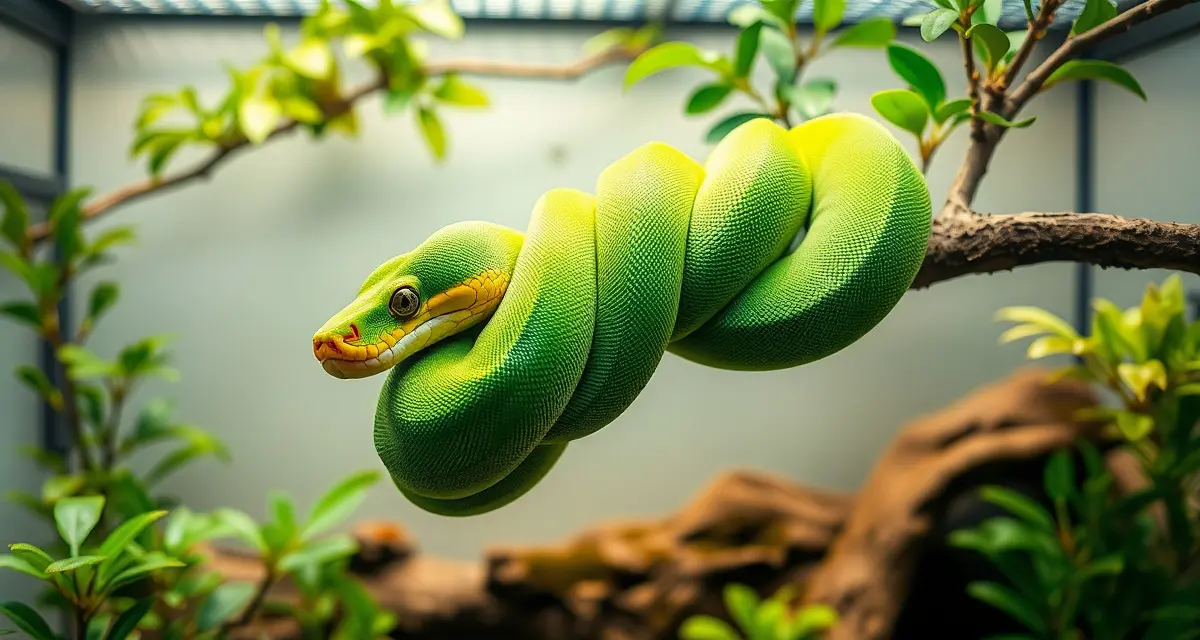
Green Tree Python Husbandry for Breeders: Complete Breeder Guide
By HatchLedger Editorial Team · Published 2025-03-03 · Updated Mar 13, 2026
Green tree python husbandry for breeding purposes goes beyond basic pet care. When you're managing animals whose health and condition directly determine the quality and quantity of your clutches, every husbandry variable matters. A female that's consistently maintained at optimal condition produces better clutches. A male that's kept in poor health may have reduced fertility. Breeders using integrated software report 30% less time on administrative tasks, freeing up the daily attention that quality GTP husbandry requires.
TL;DR
- Green tree pythons (Morelia viridis) are arboreal specialists requiring perch-based enclosures and husbandry quite different from terrestrial pythons.
- Breeding is triggered by a dry season simulation with reduced humidity and a modest temperature reduction over 6-8 weeks.
- Clutch sizes average 12-25 eggs, with Biak locale animals producing larger clutches than Sorong or Aru.
- Incubation runs 47-52 days at 84-86 degrees Fahrenheit, shorter than most python species at equivalent temperatures.
- Locale documentation is critical: Biak, Sorong, Aru, Kofiau, and locality blends all carry distinct market values and buyer expectations.
This guide focuses specifically on breeding-oriented husbandry, covering the care decisions that affect breeding outcomes rather than just animal survival.
Housing for Breeding GTPs
Enclosure Type and Size
Adult breeding GTPs need arboreal enclosures that support perching, appropriate temperature gradients, and humidity control. Screen enclosures provide excellent ventilation but can make humidity maintenance difficult in dry climates. PVC or fiberglass enclosures with front ventilation are popular choices because they hold humidity better.
For adult females, a minimum enclosure size of 24" x 24" x 36" is appropriate. Males can be kept in slightly smaller setups. Ensure each enclosure has a main perch at mid-height, additional climbing options, and enough space that the animal can move between temperature zones.
Do not cohabitate GTPs except for supervised breeding introductions. GTPs are solitary and territorial; cohabitation causes chronic stress that degrades condition and breeding performance.
Perch Setup
Perches should be horizontal or gently angled, approximately the diameter of the snake's mid-body. GTPs spend most of their lives coiled on perches and will choose their preferred temperature zone by moving between perches at different heights. Provide at least two perch options at different heights to support natural thermoregulation.
Natural branches, PVC pipe wrapped in sisal or cork bark, and commercially available arboreal perches all work well. Clean and inspect perches regularly for mold in high-humidity environments.
Humidity
Humidity requirements for GTPs sit between 60-80% ambient with misting to 90%+ daily or twice daily. Most breeders mist in the morning and again in the early evening. This mimics natural rainfall patterns and gives the enclosure time to partially dry between mistings, preventing stagnant conditions that promote bacterial growth.
Track your actual humidity with a reliable digital hygrometer, not just by feel. Humidity management that looks adequate by casual observation can be significantly off target. Log temperature and humidity readings periodically in your animal records so you can identify environmental inconsistencies that might be affecting a female's condition or breeding response.
Temperature Management
GTPs are from equatorial environments but still benefit from a thermal gradient. Maintain a warm zone of 84-88°F during the day and allow a slight nighttime drop to 76-80°F. This daily thermal seasonal cycling supports natural activity patterns and is part of the seasonal cycling protocol for breeding.
The warm zone is typically provided by a basking element positioned above the upper perch zone, though GTPs aren't strong baskers. The goal is ambient warmth from the top of the enclosure down, with cooler temps toward the bottom.
During breeding cycling, you'll intentionally shift this gradient. The dry phase of breeding cycling involves allowing nighttime temps to drop further, to 72-76°F. The wet phase returns temps to normal ranges. Log these environmental adjustments in your breeding records alongside the dates, so you can correlate them to breeding outcomes when reviewing past seasons. HatchLedger's reptile breeder hub is designed to store this kind of contextual data alongside your animal and clutch records.
Feeding Protocols for Breeding Adults
Prey Selection and Sizing
Adult GTPs eat mice and rats. Prey size should match roughly the widest point of the snake's body. Appropriately sized prey leads to cleaner feeding responses and reduces regurgitation risk.
Frozen-thawed prey is strongly preferred from a biosecurity and convenience standpoint. Source feeders from reputable suppliers and store them properly.
Feeding Frequency
Adult GTPs don't need to eat as frequently as some other snake species. Most adult females do well on a feeding schedule of every 7 to 14 days. Males can be fed slightly less frequently.
Pre-breeding conditioning for females involves increasing feeding frequency slightly in the months before cycling begins. This builds the body condition and fat reserves that support follicle development. Log every feeding event with date, prey type, prey weight, and outcome. Refusals during the dry phase of breeding cycling are expected and normal.
Body Condition Scoring
Weigh your breeding females monthly outside of breeding season, and weekly during active breeding and gestation. A female entering the breeding season should have:
- Good muscle tone when handled
- Rounded cross-section without excess lateral fat deposits
- Healthy skin and eye condition
- Reliable feeding response in the months prior
A female that is too thin won't produce quality follicles. A female that is obese may cycle poorly and face health risks during gestation. Log weights consistently so you can track trends over time rather than relying on visual assessment alone.
Health Monitoring as Part of Husbandry
Daily Observation
The most important husbandry habit for breeders is daily observation. A quick visual check of each animal at feeding time catches early health changes before they become serious problems. Look for:
- Normal resting posture on perch
- Clear eyes and nares
- Normal coloration
- No visible injury or swelling
- Alert response when disturbed
Any deviation from normal should be logged and monitored.
Shed Tracking
Log every shed date and assess completeness. GTPs should have clean, complete sheds when humidity is appropriate. Retained shed, especially retained eye caps, indicates a husbandry issue or health problem that needs attention before it affects breeding performance.
Pre-Breeding Health Assessment
Before introducing any female to a breeding cycle, assess her health status. An animal recovering from illness, dealing with an active parasite load, or in poor condition should not be cycled. The stress of breeding and egg production on an unhealthy animal can be seriously damaging.
If you have any concerns, a pre-breeding vet check is worthwhile. The cost of a vet visit is small compared to the value of a healthy, productive breeding female.
Integrating Husbandry Records with Breeding Outcomes
The real value of thorough husbandry records comes when you can connect them to breeding results. A female that was maintained at slightly lower weights during conditioning produced smaller clutches. A male that had a respiratory infection mid-season and produced low fertility rates in all pairings that season points to how his health affected outcomes.
These correlations only become visible when your records connect husbandry data to breeding data in the same system. That's exactly what separates reptile breeder software comparison winners from basic tools: the ability to link care history to outcomes in a single searchable view.
Frequently Asked Questions
What is the best approach to green tree python husbandry for breeders?
Focus on consistency and documentation. Maintain stable humidity at 60-80% ambient with daily misting spikes, provide a proper thermal gradient with 84-88°F warm zones and nighttime drops, and feed appropriately sized frozen-thawed prey on a regular schedule. Weigh breeding females monthly, log all feedings and sheds, and conduct a health assessment before each breeding season. Breeding-quality husbandry goes beyond basic care; it specifically optimizes female body condition and male health for the demands of reproduction.
How do professional breeders handle green tree python husbandry for breeders?
Professional GTP breeders treat husbandry as a data-driven practice. They track environmental conditions, feeding outcomes, and weight trends consistently across their collection. They adjust feeding schedules seasonally to support pre-breeding conditioning. They monitor shed quality and health markers regularly, conduct pre-breeding health checks, and document everything in a system that connects husbandry records to breeding outcomes. This data allows them to identify which husbandry decisions produce the best breeding results and refine their protocols season over season.
What software helps manage green tree python husbandry for breeders?
HatchLedger is purpose-built for reptile breeders, connecting animal records, breeding history, clutch outcomes, and financial tracking in one system. Unlike generic spreadsheets, it's designed around the specific workflow of an active breeding season. Free for up to 20 animals.
Why is locale documentation so important for green tree pythons?
Buyers of green tree pythons are often very specific about locality. Biak animals are prized for large adult size and a blue ontogenetic coloration phase. Sorong and Aru animals are known for consistent solid green adult coloration. Locality blends from unknown crosses are worth significantly less than documented pure-locale animals. Recording locale information from acquisition through sale is essential.
How long does it take green tree python neonates to change color?
The ontogenetic color change from yellow or red neonate coloration to adult green takes approximately 6-12 months in most locales. Biak animals often go through a blue phase during the transition. Buyers of neonates should understand the timeline. Photographing animals at regular intervals through the color change documents the process and makes for compelling sales content.
What is Green Tree Python Husbandry for Breeders: Complete Breeder Guide?
This is a comprehensive husbandry reference specifically designed for green tree python breeders, not casual keepers. It covers enclosure setup, temperature and humidity management, dry season cycling to trigger breeding, locale documentation, clutch incubation, and neonatal care. The guide treats every husbandry variable as a breeding variable, recognizing that female condition drives clutch quality and size, and that locale integrity directly affects animal value in the breeder market.
How much does Green Tree Python Husbandry for Breeders: Complete Breeder Guide cost?
The guide itself is free to read on HatchLedger. It is an editorial resource, not a paid product. HatchLedger does offer breeding record-keeping software that integrates with the practices described in the guide, and that platform has its own pricing. Breeders who want to track husbandry logs, clutch data, and locale documentation alongside this guidance can explore that tool separately.
How does Green Tree Python Husbandry for Breeders: Complete Breeder Guide work?
The guide walks breeders through each phase of the GTP breeding cycle: baseline husbandry, dry season simulation over 6-8 weeks with reduced humidity and a modest temperature drop, pairing, egg deposition, and incubation at 84-86°F for 47-52 days. It treats husbandry decisions as breeding decisions, explaining how enclosure conditions, feeding schedules, and male and female condition interact to determine clutch outcomes.
What are the benefits of Green Tree Python Husbandry for Breeders: Complete Breeder Guide?
The primary benefit is treating husbandry as a production variable rather than basic animal care. Breeders who optimize female condition consistently see better clutch sizes. The guide also emphasizes locale documentation, which protects the market value of animals from Biak, Sorong, Aru, and Kofiau lines. Breeders using integrated record-keeping software alongside the guide report spending 30% less time on administrative tasks, freeing time for hands-on animal management.
Who needs Green Tree Python Husbandry for Breeders: Complete Breeder Guide?
This guide is written for active green tree python breeders managing breeding animals, not first-time GTP keepers. It assumes baseline familiarity with snake husbandry and focuses on the variables that matter at breeding scale: female conditioning, cycling protocols, incubation management, and locale record integrity. It is also useful for breeders scaling from a few pairs to a larger collection who want a systematic, repeatable husbandry framework.
How long does Green Tree Python Husbandry for Breeders: Complete Breeder Guide take?
The husbandry practices described are ongoing, not a one-time process. The dry season cycling protocol runs 6-8 weeks. Incubation takes 47-52 days at 84-86°F, which is shorter than most python species at equivalent temperatures. Female conditioning and recovery between clutches is a year-round commitment. Breeders should expect the full breeding cycle, from cycling initiation to neonate emergence, to span roughly four to five months per season.
Related Articles
Sources
- USARK (United States Association of Reptile Keepers)
- Association of Reptilian and Amphibian Veterinarians (ARAV)
- CITES Appendix II (international trade documentation)
- Herpetofauna (Australian Herpetological Society)
- Green Tree Python Foundation
Get Started with HatchLedger
Green tree python breeding demands locale documentation, cycling records, and clutch management that generic spreadsheets handle poorly. HatchLedger keeps your locale lineage, breeding history, and per-clutch records connected so buyers get complete documentation and you build a traceable breeding program. Try it free with up to 20 animals.