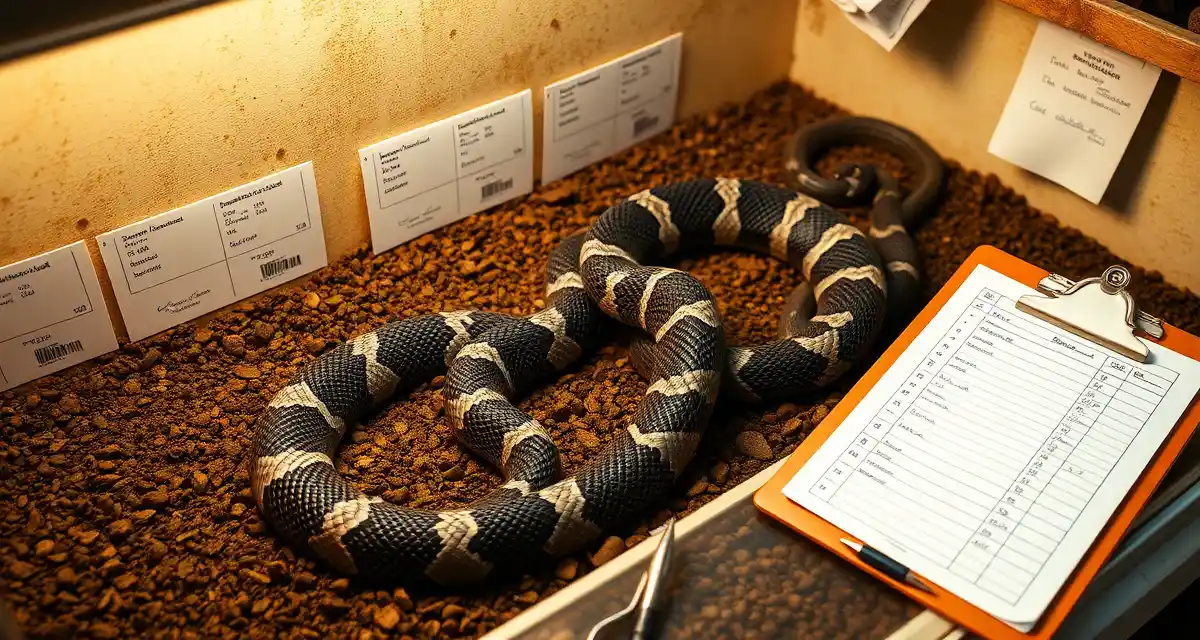
Kingsnake Record Keeping for Breeders: Complete Breeder Guide
By HatchLedger Editorial Team · Published 2025-04-09 · Updated Mar 13, 2026
Kingsnake record keeping supports three critical needs: genetic accuracy for morph documentation, safety records for managing a cannibalistic species across multiple pairings, and financial tracking that tells you whether your program is actually profitable. Breeders using integrated software report 30% less time on administrative tasks, and the complexity of kingsnake programs, spanning multiple subspecies, morph projects, and safety-sensitive pairing records, makes that efficiency especially valuable.
TL;DR
- Kingsnakes and milksnakes span the genus Lampropeltis, with numerous species and subspecies each having distinct cycling requirements.
- Most kingsnake species require 90-120 days of brumation at 45-55 degrees Fahrenheit for consistent breeding.
- Clutch size datas average 8-20 eggs depending on species, with California kingsnakes commonly producing 6-12 eggs.
- Incubation runs 55-75 days at 78-82 degrees Fahrenheit, similar to corn snakes.
- Kingsnake morph genetics overview include albino, anerythristic, and hypo lines plus combination morphs with active development in California kingsnakes, gray-banded kingsnakes, and Mexican black kingsnakes.
What Kingsnake Records Need to Capture
Animal Records
For every kingsnake in your collection:
- Unique ID
- Subspecies (California, Mexican black, Florida, Eastern, speckled, etc.)
- Morph identification (visual, het status, possible het with percentage)
- Sex
- Date acquired or hatched, breeder of origin if acquired
- Weight history (monthly)
- Feeding history
- Shed dates
- Health events
- Housing location
Subspecies documentation matters because kingsnake subspecies have different breeding seasons, clutch sizes, and morph genetics. Mixing up subspecies records creates confusion that's hard to correct later.
Pairing Safety Records
Given kingsnakes' cannibalism risk, pairing records serve a safety function beyond genetic documentation. For every introduction:
- Female ID and male ID
- Date and time of introduction
- Duration of supervised observation
- Behavioral outcome (courtship, lock-up, aggression, neutral)
- Any incidents
If an introduction went poorly, your record tells you which animals are risky to pair together again. If a pairing worked well, your record confirms that the combination is safe and productive.
Store these records in HatchLedger's reptile breeder hub where they connect to the clutch that results from each successful pairing.
Clutch Records
At lay:
- Total egg count and fertility assessment
- Lay date and female weight before/after
- Incubation parameters
During incubation:
- Candling results with dates
- Check-in notes
At hatch:
- Hatch date and hatchling count
- Individual hatchling IDs
Hatchling Records
From hatch to sale:
- ID, hatch date, weight, morph
- Feeding history from first attempt
- Weight timeline
- Sale date, price, buyer information
Financial Records
Cost and revenue tracking per clutch, per breeding pair, and per season. Your records only tell the full story when husbandry data connects to financial outcomes.
Building a System That Works at Scale
Use a consistent ID scheme applied from the start. Log events at the time they occur. Connect your physical housing labels to your digital records. Review records before each breeding season to let past outcomes guide current decisions.
Reptile breeder software comparison resources consistently identify that breeders who outgrow spreadsheets do so at the point where their records become too fragmented to support effective analysis. HatchLedger is designed so your records grow with your program without losing the connections between data points.
Frequently Asked Questions
What is the best approach to kingsnake record keeping for breeders?
Create individual records for every animal with accurate subspecies and morph documentation. Maintain detailed pairing records that serve both genetic documentation and safety management purposes. Log all clutch and hatchling data from lay through sale. Connect financial records to animal and clutch records so P&L is visible in context with the breeding history behind each sale. Use a digital system with consistent IDs and log events at the time they occur rather than from memory.
How do professional breeders handle kingsnake record keeping for breeders?
Professional kingsnake breeders maintain complete genetic records for every subspecies they work with, keep pairing records that include safety observations alongside genetic documentation, and maintain financial records connected to their animal and clutch history. They review their records seasonally to identify trends and inform next season's decisions. Most use dedicated breeding software to maintain record quality across a collection that may include multiple subspecies and ongoing morph projects.
What software helps manage kingsnake record keeping for breeders?
HatchLedger manages multi-species collections with distinct cooling protocols, morph genetics, and clutch records in one system. For kingsnake breeders working across subspecies or multiple species, keeping each animal's protocol and lineage clearly organized prevents the documentation errors that affect buyer trust. Free for up to 20 animals.
Do all kingsnake species need the same cooling duration?
No. California kingsnakes from warmer coastal localities may respond to 90 days of cooling at 50-55 degrees Fahrenheit, while gray-banded kingsnakes from higher elevation Texas habitats may benefit from 120 days at lower temperatures. Eastern kingsnakes from northern localities often need the most aggressive cooling. Research the specific ecology of your animals' locale or subspecies.
Can different kingsnake species be housed together?
Kingsnakes are ophiophagous (snake-eating) and should never be cohabited, including with animals of the same species. Even animals cohabited without incident for extended periods can result in cannibalism. This applies to breeding introductions as well: supervise all introductions and separate animals immediately after copulation.
What is Kingsnake Record Keeping for Breeders: Complete Breeder Guide?
Kingsnake Record Keeping for Breeders: Complete Breeder Guide is a comprehensive resource covering how to systematically document every aspect of a kingsnake breeding program. It addresses animal identification, morph genetics, brumation cycles, pairing safety, clutch data, incubation logs, and financial tracking. The guide is designed for breeders working across the Lampropeltis genus, including California kingsnakes, Mexican blacks, gray-banded, and milksnakes, where subspecies diversity and cannibalism risks make organized records especially critical.
How much does Kingsnake Record Keeping for Breeders: Complete Breeder Guide cost?
HatchLedger's kingsnake record keeping tools are available through the platform's subscription plans. Pricing varies by tier based on collection size and feature access. The underlying guide content is free to read on the site. For breeders who want integrated software to automate genetic tracking, pairing logs, and financial reporting, a paid plan replaces manual spreadsheets and reduces administrative time by approximately 30% according to user reports.
How does Kingsnake Record Keeping for Breeders: Complete Breeder Guide work?
The system works by assigning each animal a unique ID tied to its subspecies, morph genetics, feeding history, weight log, and pairing records. Breeders log brumation dates, pairing events, clutch sizes, and incubation parameters as they happen. The software connects paired animals, tracks offspring genetics, and generates financial summaries. Safety flags for cannibalistic pairing combinations can be attached to records, giving breeders an auditable history for every animal and season.
What are the benefits of Kingsnake Record Keeping for Breeders: Complete Breeder Guide?
Key benefits include accurate morph documentation across complex combination projects, safety records that prevent dangerous kingsnake pairings, and financial clarity on whether a breeding program is profitable. Breeders gain a searchable history of every clutch, incubation outcome, and hatchling sale. Over multiple seasons, pattern recognition improves pairing decisions, reduces errors in genetic claims, and supports buyer trust with documented lineage—particularly important when selling albino, anerythristic, hypo, and combination morph animals.
Who needs Kingsnake Record Keeping for Breeders: Complete Breeder Guide?
Any serious kingsnake breeder benefits from structured record keeping, but it is especially valuable for those managing multiple subspecies simultaneously, running long-term morph combination projects, or scaling beyond a small personal collection. Hobbyists transitioning to selling animals need documented genetics and lineage for credibility. Breeders working with gray-banded kingsnakes or Mexican black kingsnakes, where morph markets are still developing, benefit from early record discipline to establish clean genetic lines.
How long does Kingsnake Record Keeping for Breeders: Complete Breeder Guide take?
Setting up a record keeping system takes a few hours initially to enter existing animals and configure morph genetics. Ongoing data entry per animal runs roughly five to ten minutes per week during active seasons. Brumation and incubation periods require periodic log updates rather than daily entries. Breeders report that after one full breeding season using integrated software, the system largely runs on routine inputs, with financial and genetic reports generated automatically at the end of each season.
Related Articles
Sources
- USARK (United States Association of Reptile Keepers)
- Association of Reptilian and Amphibian Veterinarians (ARAV)
- California Academy of Sciences Herpetology Collection
- Herpetologica (Herpetologists League)
- Reptiles Magazine (Bowtie Inc.)
Get Started with HatchLedger
Managing multiple kingsnake species and subspecies with distinct seasonal cycling protocol requirements and active morph programs benefits from a system that keeps each animal's protocol, lineage, and clutch history clearly organized. HatchLedger connects all of that data across your collection. Free for up to 20 animals.