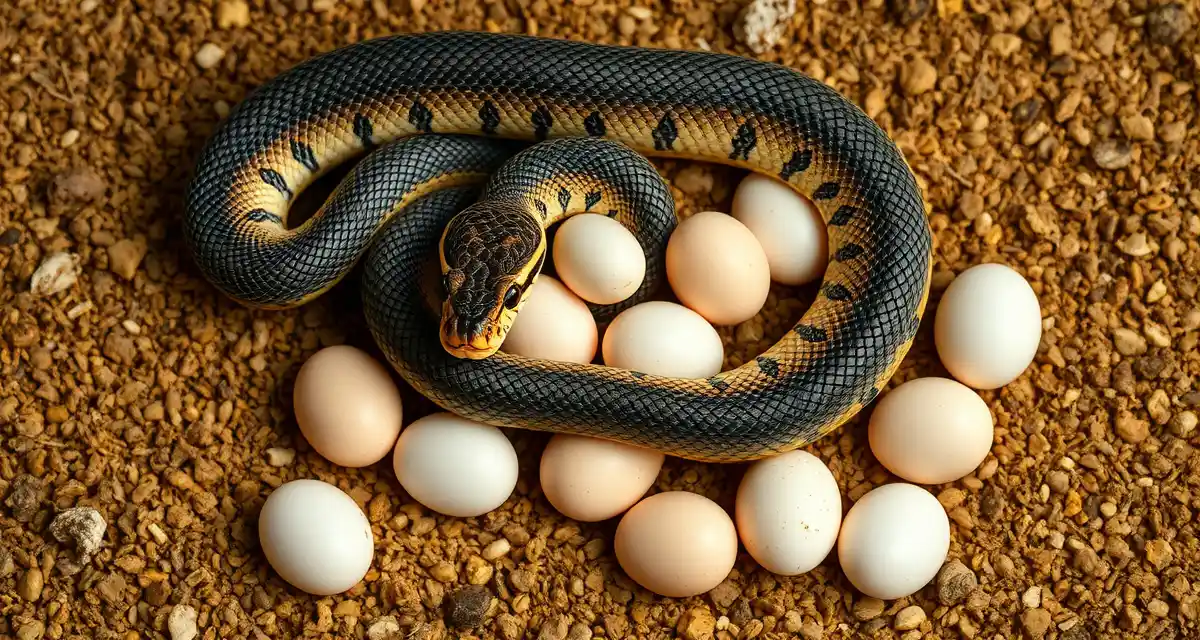
Kingsnake Clutch Size and Egg Count: Complete Breeder Guide
By HatchLedger Editorial Team · Published 2025-01-28 · Updated Mar 13, 2026
Kingsnake clutch size and egg count vary considerably by subspecies, female age, and body condition. California kingsnakes might produce 3 to 12 eggs per clutch, while Florida kingsnakes can produce 4 to 18. Mexican black kingsnakes tend toward smaller clutches of 3 to 9 eggs. Understanding what's normal for your specific subspecies and what factors drive variation puts you in a position to optimize results. Breeders using integrated software report 30% less time on administrative tasks, which means more time on the conditioning decisions that most affect clutch outcomes.
TL;DR
- Kingsnakes and milksnakes span the genus Lampropeltis, with numerous species and subspecies each having distinct cycling requirements.
- Most kingsnake species require 90-120 days of brumation at 45-55 degrees Fahrenheit for consistent breeding.
- Clutch sizes average 8-20 eggs depending on species, with California kingsnakes commonly producing 6-12 eggs.
- Incubation runs 55-75 days at 78-82 degrees Fahrenheit, similar to corn snakes.
- Kingsnake morph genetics overview include albino, anerythristic, and hypo lines plus combination morphs with active development in California kingsnakes, gray-banded kingsnakes, and Mexican black kingsnakes.
Subspecies and Expected Clutch Ranges
Kingsnakes (Lampropeltis spp.) include numerous subspecies with different geographic origins and typical clutch sizes. Before trying to optimize clutch size, know what your subspecies typically produces:
- **California kingsnake (L. californiae):** 4 to 12 eggs, averaging 7 to 9
- **Florida kingsnake (L. getula floridana):** 6 to 18 eggs
- **Eastern kingsnake (L. getula getula):** 6 to 17 eggs
- **Mexican black kingsnake (L. getula nigrita):** 3 to 9 eggs
- **Speckled kingsnake (L. holbrooki):** 8 to 22 eggs
These ranges assume adult females at optimal condition. First-time breeders typically produce smaller clutches at the low end of the range.
What Drives Clutch Size Variation
Female Age and History
Young females in their first or second breeding season produce smaller clutches than established adults. Clutch size tends to peak when females reach mature adult size for their subspecies, then gradually declines in very old animals. Track your breeding females' age and clutch history across seasons.
Pre-Breeding Condition
Body condition at the start of the breeding season is the primary controllable factor. A female that enters brumation at healthy weight, comes out in good condition, and eats well before introduction consistently produces better clutches than one that was underconditioned.
Weigh females monthly throughout the year and log weights in your animal records. A female losing weight heading into the seasonal cycling protocol period needs attention before the season begins.
Cooling Quality
Adequate cooling at appropriate temperatures for the full recommended duration produces more reliable clutch sizes. Shortcuts in the cooling protocol, whether shorter duration or warmer temperatures, tend to result in smaller clutches and higher slug rates.
Recording Clutch Data
At lay, record:
- Total egg count
- Visible fertility assessment (firm white eggs vs. yellowed, deflated slugs)
- Lay date
- Female weight before and after laying
Candle at 10 to 14 days to confirm fertility. Log candling results per egg in your clutch record. Remove confirmed infertile eggs at this point.
Connect your clutch data to your female's conditioning history in HatchLedger's reptile breeder hub so you can identify correlations between her condition and her clutch size across seasons.
Double Clutching
Many kingsnake subspecies double clutch reliably in captivity. If a female resumes eating aggressively after her first lay and her condition is good, a second clutch 4 to 6 weeks later is possible. Don't force a second clutch from a female whose condition is borderline; long-term health matters more than maximum annual production.
Log whether females double clutch each season and compare first versus second clutch sizes. This data helps you plan for production volume and inventory management.
Reptile breeder software comparison tools that connect clutch records to financial outcomes let you calculate whether double clutching from specific females is producing a meaningful revenue increase relative to the additional care investment.
Frequently Asked Questions
What is the best approach to kingsnake clutch size and egg count?
Know your subspecies' typical range and optimize female condition throughout the year, not just during breeding season. Proper cooling for the full recommended duration, combined with good pre-breeding feeding, consistently produces clutches toward the upper end of your subspecies' range. Log clutch data completely at lay and at candling, and review clutch sizes alongside female condition records to identify correlations. Track double clutch data separately to assess whether your second clutches are worth the additional effort.
How do professional breeders handle kingsnake clutch size and egg count?
Professional kingsnake breeders track female weights year-round, condition females with appropriate feeding before cooling begins, and conduct complete cooling protocols without shortcuts. They record every clutch measurement and compare results across seasons. They identify their highest-producing females and prioritize their care investment accordingly. Many track the financial value of each clutch against production costs to assess whether specific breeding pairs are generating appropriate returns.
What software helps manage kingsnake clutch size and egg count?
HatchLedger manages multi-species collections with distinct cooling protocols, morph genetics, and clutch records in one system. For kingsnake breeders working across subspecies or multiple species, keeping each animal's protocol and lineage clearly organized prevents the documentation errors that affect buyer trust. Free for up to 20 animals.
Do all kingsnake species need the same cooling duration?
No. California kingsnakes from warmer coastal localities may respond to 90 days of cooling at 50-55 degrees Fahrenheit, while gray-banded kingsnakes from higher elevation Texas habitats may benefit from 120 days at lower temperatures. Eastern kingsnakes from northern localities often need the most aggressive cooling. Research the specific ecology of your animals' locale or subspecies.
Can different kingsnake species be housed together?
Kingsnakes are ophiophagous (snake-eating) and should never be cohabited, including with animals of the same species. Even animals cohabited without incident for extended periods can result in cannibalism. This applies to breeding introductions as well: supervise all introductions and separate animals immediately after copulation.
What is Kingsnake Clutch Size and Egg Count: Complete Breeder Guide?
This guide covers everything kingsnake breeders need to know about clutch size and egg count across subspecies. California kingsnakes typically produce 3-12 eggs per clutch, Florida kingsnakes 4-18, and Mexican black kingsnakes 3-9. It explains how female age, body condition, brumation quality, and subspecies genetics influence clutch outcomes, and how tracking these variables over multiple seasons helps breeders optimize their programs and anticipate results more accurately.
How much does Kingsnake Clutch Size and Egg Count: Complete Breeder Guide cost?
This is a free educational resource for reptile breeders. There is no cost to read the guide. HatchLedger provides this information to help breeders make informed decisions about kingsnake husbandry and breeding. Optional breeding management software is available separately for breeders who want to track clutches, incubation data, and pairing records digitally, reducing administrative time so more focus goes toward the conditioning decisions that drive results.
How does Kingsnake Clutch Size and Egg Count: Complete Breeder Guide work?
The guide works by breaking down clutch size variation by subspecies, then explaining the biological and husbandry factors behind that variation. Breeders learn what brumation temperatures and durations kingsnakes require (45-55°F for 90-120 days), how to assess female body condition before pairing, what incubation parameters to target (78-82°F for 55-75 days), and how to interpret clutch outcomes season over season to refine their approach.
What are the benefits of Kingsnake Clutch Size and Egg Count: Complete Breeder Guide?
The primary benefit is understanding what clutch sizes are normal for your specific kingsnake subspecies, so you can distinguish natural variation from husbandry problems. Breeders who understand the baseline ranges for California, Florida, and Mexican black kingsnakes can set realistic expectations, identify underperforming animals earlier, and make better decisions about feeding, cycling, and pairing timing. Better data leads to better outcomes across successive breeding seasons.
Who needs Kingsnake Clutch Size and Egg Count: Complete Breeder Guide?
This guide is useful for hobbyist breeders producing their first clutches, experienced keepers expanding into new kingsnake subspecies, and anyone transitioning from casual keeping to a structured breeding program. It is particularly relevant for breeders working with California kingsnakes, gray-banded kingsnakes, or Mexican black kingsnakes, where morph genetics and clutch predictability are increasingly important to managing a productive collection.
How long does Kingsnake Clutch Size and Egg Count: Complete Breeder Guide take?
Kingsnake breeding follows a defined annual cycle. Brumation lasts 90-120 days, followed by a warm-up period and pairing. Gravid females typically lay 55-75 days after successful copulation. Incubation then runs another 55-75 days at 78-82°F before hatchlings emerge. From the start of brumation to first hatchlings, breeders should plan for roughly 7-9 months. Tracking each stage carefully across seasons helps identify where timing adjustments can improve clutch size and fertility.
Sources
- USARK (United States Association of Reptile Keepers)
- Association of Reptilian and Amphibian Veterinarians (ARAV)
- California Academy of Sciences Herpetology Collection
- Herpetologica (Herpetologists League)
- Reptiles Magazine (Bowtie Inc.)
Get Started with HatchLedger
Managing multiple kingsnake species and subspecies with distinct cooling requirements and active morph programs benefits from a system that keeps each animal's protocol, lineage, and clutch history clearly organized. HatchLedger connects all of that data across your collection. Free for up to 20 animals.